|
Historical merit badges help Boy Scouts celebrate Scouting’s past
Requirements
The
following new, or should I say OLD merit badges will count are now
available for you to earn as electives for rank advancement. They
are Signaling, Pathfinding, Tracking and Carpentry
In
honor of the BSA’s 100th Anniversary, Scouts will get the unique
opportunity to experience some of the activities their
predecessors enjoyed. That’s possible thanks to the BSA’s new
Historical Merit Badge Program, a set of four discontinued merit
badges that today’s Scouts can earn.
Boys
can earn any or all of these merit badges:
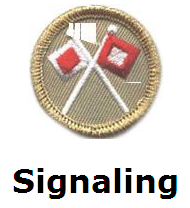
First
offered in 1910 and discontinued in 1992.
Probably
the most difficult of the resurrected badges is Signaling.
Scouts will need to learn both Morse Code and Semaphore. Build
your own Morse Code signalers, or take a trip to the Washington
State History Museum in Tacoma, where they have Morse Code
stations set up. For Semaphore, find out which parents are
affiliated with the Navy. Or contact the Sea Scouts at the SSS
Hurricane in Port Orchard. There are some of the Scouters on board
the USS
Turner Joy possess this skill. An overnighter on that restored
ship may be the perfect time and place for your Scouts to learn
this skill.
Requirements:
-
Make an electric buzzer outfit, wireless, blinker, or other signaling
device. Send and receive in the International Morse Code, by buzzer or other
sound device, a complete message of not less than 35 words, at a rate of not
less than 35 letters per minute.
-
Demonstrate an ability to send and receive a message in the International
Morse Code by wigwag and by blinker or other light signaling device at a
rate of not less than 20 letters per minute.
-
Send and receive by Semaphore Code at the rate of not less than 30 letters
per minute.
-
Know the proper application of the International Morse Code and Semaphore
Codes; when, where, and how they can be used to best advantage.
-
Discuss briefly various other codes and methods of signaling which are in
common use.

First
offered in 1911 and discontinued in 1952.
The
kindler, gentler BSA term for the second badge is now Tracking.
It used to be Stalking. Understandable why it was changed.
Requirements:
-
Demonstrate by means of a stalking game or otherwise, ability to stalk
skillfully in shelter and wind, etc., when occasion demands.
-
Know and recognize the tracks of ten different kinds of animals or birds
in his vicinity, three of which may be domestic.
-
Submit satisfactory evidence that he has trailed two different kinds of
wild animals or birds on ordinary ground far enough to determine the
direction in which they were going, and their gait or speed. Give names of
animals or birds trailed, their direction of travel, and describe gait and
speed; or submit satisfactory evidence that he has trailed six different
kinds of wild animal or birds in snow, sand, dust or mud, far enough to
determine the direction in which they were going, and their gait or speed.
Give names of animals or birds trailed, their direction of travel, and
describe gait and speed.
-
Submit evidence the he has scored at least 30 points from the following
groups: [Group (f) and 4 of the 5 groups (a), (b), (c), (d), (e) must be
represented in the score of 30 and at least 7 points must be scored from
(a), (b), or (c)].Make a clear photograph of:
|
a.
|
Live bird away from nest
|
4 points
|
|
b.
|
Live woodchuck or smaller wild animal
|
3 points
|
|
c.
|
Live wild animal larger than woodchuck
|
4 points
|
|
d.
|
Live bird on nest
|
3 points
|
|
e.
|
Tracks of live wild animal or bird
|
2 points
|
|
f.
|
Make satisfactory plaster cast of wild animal or bird tracks with
identification imprint on back of each
|
2 points
|
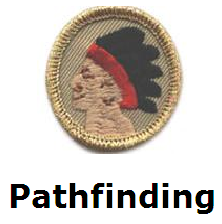
First offered in 1911 and discontinued in
1952.
Requirements:
-
Demonstrate a general knowledge of the district within a
three-mile radius of the local Scout Headquarters, or his house so
as to be able to guide people at any time day or night to points
within this area.
-
Know the population
of the five principal neighboring towns and cities as selected
by his Guide or Counselor. Demonstrate direction for reaching them
from Scout Headquarters or his house.
-
If in the country, know the breeds of horses, cattle, sheep and
hogs owned on the five neighboring farms; if in the city,
demonstrate directions to tourist camp and to five places for
purchasing food supplies.
-
Demonstrate how to direct tourists from his home to gas, oil,
tire, and general auto repair.
-
Give telephone number, if any, and directions for reaching the
nearest police station, fire-fighting apparatus, Court House or
Municipal Building, the nearest Country Farm Agent’s office,
doctor, veterinarian and hospital.
-
Know something of the history of his community and the location
of its principal places of interest and public buildings.
-
Submit a scale map, not necessarily drawn by himself, upon
which he has personally indicated as much of the above-required
information
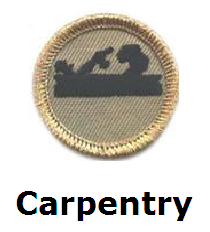
First
offered in 1911 and discontinued in 1952.
The
Carpentry badge, first offered in 1911 and
discontinued in 1952, offers boys an introduction to construction.
Most of the badge is learning how to use tools, but there is a
furniture making requirement as well. This is great to pair with
either Home
Repairs or Woodwork.
You might even turn this into a troop project, repairing a
senior’s home.
Requirements:
-
Demonstrate the use of the rule, square, level, plumb-line, miter,
chalk-line and bevel.
-
Demonstrate the proper way to drive, set, and clinch a nail, draw a spike
with a claw-hammer, and to join two pieces of wood with screws.
-
Show correct use of the cross-cut saw and of the rip-saw.
-
Show how to plane the edge, end and the broad surface of a board.
-
Demonstrate how to lay shingles.
-
Make a simple article of furniture for practical use in the home or on the
home grounds, finished in a workmanlike manner, all work to be done without
assistance.
These
are all great opportunities to earn merit badges…but there’s
one catch: You must start and finish all requirements within the
year 2010. So if you built furniture at last year’s summer camp,
for the Carpentry merit badge it won’t count because all of the
requirements have to be done in 2010. And after Dec. 31, 2010,
these merit badges will go back on the “retired” list.
Thanks
to Patrick M for this page.
|

 Boy Scout Troop 505